Find the website here.
Bill Nye the Science Guy has been a hero of mine for as long as I can remember seeing his shows on TV and in grade school classrooms. He's now got this cool new website "Bill's Climate Lab" to show how everyone can make a difference in the fight against global climate change. It's really neat!
At first I thought it would be lots of "kids stuff" I already knew, but it actually has some pretty solid science and I realized it is actually more focused for adults more than kids.
Bill Nye is the coolest, ever!
Showing posts with label what you can do. Show all posts
09 May 2011
03 May 2011
Human Overpopulation
![]() |
| Wear a condom now... save the spotted owl. The Center for Biological Diversity was handing these out at ISTS in April. They're condom packages that feature various endangered species and provide information about humankind's overpopulation of Earth and the trouble it has caused for various endangered species. Humans are the most populous mammals on this planet, and we consume most of the natural resources available. We cut down trees that may have once been shelter for a tree frog, bird, beetle, monkey, or some other animal. We pollute bodies of water, home to dozens of species of fish, frogs, etc. We develop coastal areas for our own living, and destroy the nesting areas for sea turtles and the habitats of hundreds of other species. You get the picture. As more and more of us populate the Earth, we are running out of resources for even ourselves. (See post on Earth Overshoot Day) So if you and your significant other are planning on having a hundred kids, please think again. Don't have more than two (to replace you two). Even better, adopt. Find more at http://www.endangeredspeciescondoms.com/ |
13 April 2011
Blue Marbles
The story behind the blue marbles...
"When you've been given a blue marble, it is a gift to you for the good work you are doing for the planet. Over one million blue marbles are traveling from person to person right now.
Hold your marble in front of you: this is how our planet appears from 1 million miles away.
Look closely into your blue marble at a light: in that much seawater you'll find an abundance of life and virtually every element.
Hold your marble to your head and think of someone who helps heal the world.
Hold it to your heart, and imagine presenting your blue marble as a gift to them with a simple, "thanks for doing what you are doing".
Carry your marble until you find the right person to give it to. Then, ask them to pass it along too. This is all we have: our only home, a fragile and beautiful blue marble."Taken from bluemarbles.org
Yesterday I received a blue marble from the See Turtles table at ISTS. Made my day!
18 March 2011
Plastic vs. Paper vs. Reusable cloth bags
I am getting absolutely SICK of these new articles that say plastic bags are more environmentally friendly than paper.
Can infants/toddlers and animals get caught in plastic and suffocate? Less likely.
Does plastic degrade in the environment? Not for hundreds if not thousands of years. (Nobody knows—they've only been around for half a century)
Not to mention, the only locations that recycle plastic bags are usually grocery stores. You know where you can recycle paper bags? Anywhere that takes paper.
Oh thats funny, because I HAVE been using my reusable bags for over a year. I DO reuse paper bags until they rip or something and then I recycle them. People act like these actions are too inconvenient and stressful, when really, it's so simple I don't even think about it anymore.
03 March 2011
How I Reduced My Plastic Consumption Today!
I managed to get some grocery shopping done today, and the first thing on my list was granola. I was at Whole Foods, my favorite place in the world, and walked down the cereal aisle grabbing a bag of Galaxy Granola—which is totally delicious by the way—realizing that it was in a plastic bag but not seeing anything that I could do about it. So I thought!
On the left is the bag of granola I ended up getting! Same brand as the one on the right but no plastic packaging!
The next aisle over they had rows and rows of chopped nuts, dried fruits, chocolate-covered goodies, grains, and GRANOLA in
self serve boxes, sold by the pound. I literally stood there for 15 minutes deciding whether I wanted to buy the granola in a plastic bag, or scoop out a pound of it myself and not have to waste plastic.

In the end I put the bag back and scooped out some unpackaged granola (SAME BRAND—
Galaxy Granola!!) into a paper bag I was reusing from a previous trip to Whole Foods. It
ended up weighing 1.15 lbs, which at $4.99/lb came out to be $5.73 or something like that. I can't remember what the pre-packaged Galaxy Granola cost (it was around $5). However, a single bag of Galaxy Granola only contains 0.75 lbs of granola (12 oz).
So in the end I definitely paid less for more, and didn't use plastic!
SCOOOORE!
02 March 2011
What I Learned From "Bag It"
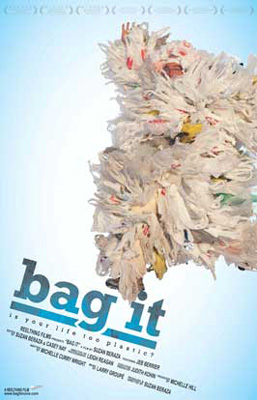
Bag It is a documentary that follows the live of an average man as he discovers more and more about the world of plastic around us. I can honestly say that this movie changed my life for the better, I am so glad I decided to get off my butt and go see it! It is definitely a must see if you care about your health and the health of those around you!
Before I saw the movie Bag It, I had failed to notice that 99.9% of items sold at the market come packaged in plastic:
- You weigh out your produce in plastic bags.
- Berries come in plastic containers.
- Jam, peanut butter, syrup, ketchup, mustard, and spices come in plastic containers (if not glass).
- Even apples, oranges, and other foods with skins that act as “natural” packaging come wrapped in plastic.
- Cereal comes in plastic.
- Disposable plastic cups and utensils come in plastic bags.
- Cookies and candy are sold in plastic packaging.
- Bubble-wrap is plastic.
- Soda, juices, and water come in plastic bottles.
- DVDs and CDs are in plastic cartridges.
- What’s your Xbox controller made of? Guitar Hero guitar?Plastic.
- Soap, shampoo, and hair care products all come in plastic bottles.
I cut down that list to make this post shorter, but I hope you get the point. I never really thought of how much I consume, or cared to notice how much of what I bought ended up being thrown out. Having written multiple pieces about plastics for work and researched the Great Pacific Garbage Patch for school, I don’t know why I haven’t caught on earlier that plastic is everywhere, and it’s a problem. A simple enough problem, isn’t it? When we no longer want the plastic we just throw it away…
But where is “away?” “Away” means either in the recycling, or in the trash.
Just recieved an email with this photo from the Husky Energy Action Team (HEAT),
an environmental club at Northeastern University.
Most likely plastic goes in the trash. The movie is great in that it clearly shows how confusing recycling can be to people, and uncovers the reality that most plastics are not recycled anyway. When plastic bags are thrown away in trash they are easily blown away ending up caught in trees, storm drains, and creeks. They eventually make it into the ocean and kill close to 100,000 marine animals every year. THEY KILL SEA TURTLES :( So let’s stop using single use plastic bags, right? Reusable ones are more stylish anyway! And so are reusable water bottles! Have you realized that Evian is Naïve spelled backwards? Now you should feel like an idiot when you purchase a plastic water bottle. NEWS FLASH: Drinking from your tap is sexy and smart.
You may think that recycling is the best alternative, but that’s totally false (sorry to burst your bubble). Plastic bottles cannot be recycled into new bottles, the plastic is “downgraded” through the recycling process. So the best thing would be to just avoid them entirely. That's why "reduce" comes before "reuse" and "recycle." Something I didn't know until I watched Bag It.
In Bag It the narrator, an average dude, started off discovering problems with plastic bags. But the problems grew to problems with plastic bottles, which then led to problems with plastic food packaging. Problems with packaging led to chemicals in baby products and chemicals in products designed for everyday use. This ordinary guy just kept digging deeper and found not just plastic bags to be the problem, but the whole concept of “throw-away living” to be entirely destructive to the environment and the human body. It turned out that plastic bags were just the “tip of the iceberg.” There are so many other shocking issues brought up in this movie, I really hope you go see it for yourself.
Now that I've seen Bag It here are some things that I've been doing to minimize the plastic I consume.
- Absolutely NO plastic bottles of any kind. Bye-bye soda, it's been nice knowing you.
- Stop placing my produce in plastic bags at the grocery store. Whole Foods has paper bags now! And I plan on reusing them over and over again until they wear out. Eventually I'll either buy or make my own reusable mesh bags to take with me.
- Bring my reusable bags to the mall—not just the grocery store. On second thought, I am going to limit my trips to the mall, too.
- I have stopped microwaving food contained in plastic containers. After what I saw in the film, there is no way I can go back.
- Also at the grocery store, if there is a brand of peanut butter (or something else) in a plastic container and one in a glass container—I'll always go with the glass. The jars can be cleaned and reused around the house or they're easily recycled.
- Cut out canned food as much as possible. According to the movie aluminum cans are lined with a layer of plastic inside.
- My buddy and I get made fun of at school for picking plastic bottles out of the trash and throwing them into the recycling, but I'm going to keep doing it for the sake of generations to come. Plus that means more landfill space.
- Avoid products with tons of packaging, and avoid buying new products. Hello thrift stores! (There are three located conveniently near my house, so I can still get my shopping fix in. Also—you find great things you may not find anywhere else at thrift stores!)
Well these are just a few things I'm doing/planning on doing. There are probably others I'm overlooking! Make it a new part of your daily life to notice the overwhelming amount of plastic around you, and try to decrease your own impact!
Rubber duckies are made of plastic loaded with phthalates (chemicals that give the plastic its flexibility), which are highly toxic. Hooray for poisoning our children! Why are phthalates bad? Lower sperm counts, for one. Gender neutrality is occurring—boys are becoming more feminine and girls are becoming more masculine. And phthalates have been linked to ADHD symptoms. How do I avoid phthalates? Here's a link to one helpful website.
The serious health and environmental concerns resulting from our plastic manufacture and consumption are issues that need to be addressed by individuals like you and me. Unfortunately, our government is doing and will do absolutely nothing to protect its citizens from toxic chemicals that are found in plastic products. The only way we’re going to see change is if local communities and individuals like you and me make conscious decisions to refuse, reduce, reuse, and recycle (listed in order of importance!).
For more visit www.bagitmovie.com!23 February 2011
Bag the Plastics & Save Turtles
Here's a little bit I wrote for the upcoming STRP newsletter:
Reduce Your Plastic Use to Save Sea Turtles
The growing amount of plastic waste in our oceans raises alarm for the safety and wellbeing of endangered sea turtles. Ingestion of plastic material or entanglement causes sea turtles to drown or die of starvation. By reducing the amount of plastic we release into our oceans we can drastically decrease the number of sea turtles that are dying due to plastics.
Many cities have enacted bans on single use plastic bags distributed for convenience at grocery stores, which will reduce the amount of bags released into storm drains and creeks, and ultimately decrease the amount of plastic that reaches the sea. Bringing reusable bags to the grocery store, choosing paper instead of plastic bags at checkout, and carrying a reusable water bottle instead of buying plastic bottles are simple actions that could make a world of difference in the protection of marine life and sea turtles.
Here's a youtube vid I made last month for STRP's "Bag the Plastics" campaign:
22 February 2011
What YOU Can Do #2 - Don't Stomp on Mother Earth with Your Footprint
One way we can all help not only precious sea turtles but all living things on Earth is to reduce our carbon footprints! There's been talk about our carbon footprints for a number of years now, but how many of us have actually gone online and taken a footprint survey or quiz to find out exactly how many resources we use as individuals? Probably like 0.1%—I mean, the only reason I ever did it was because I was doing it for a school assignment.
The truth is, most of us avoid thinking about it because what you end up finding out is quite frightful. For example, I'll use the survey that I did today on the Global Footprint Network's website.

If you couldn't tell the image above says that if everyone were to live like me, we would need 7 planet Earths. 7!!!! Can someone remind me again how many we have? Oh, right. Just one. So basically, you could say I am out to destroy the world with my ways of living.
One of my problems is materials consumption. What chica does not love to shop?! Honestly. But overall, it's a habit that has been destructive to both the Earth and my bank account. I just need to stop. So if you find yourself constantly buying new things, try shopping at thrift stores or consignment stores, or try to appreciate the things you already have. In the end you'll save yourself a lot of money, and you'll conserve a lot of important resources.
My biggest problem is the carbon emissions from travel, since I have to travel coast to coast from California to Massachusetts every year for school (which is about 6 hour flight each way). I also lost my carpooling partner and now I have to drive to work everyday. Not to mention public transportation here SUCKS compared to Boston. (I LOVE THE T!!!) I can't wait until I'm home for summer and I can just bike everywhere!!!
I love biking, especially with this girl!!
If you're finding that transportation eats up a lot of your carbon emissions, try public transit or riding a bike! Try carpooling! Carpooling was an amazing experience for me while it lasted. The woman I drove with pointed out great restaurants and things to do, and we chatted about everything. Also it's relaxing not to worry about driving sometimes.
I am a strict vegetarian, and I buy whatever is local from Whole Foods. My bread comes from the town I live in. If I do eat dairy products I'm lucky enough to live close to a lot of dairy farms. And when I visit home, my mom has become a farmers market fiend and uses a lot of local produce in her cooking. Even for all you carnivores out there, you don't have to eat meat with EVERY MEAL.
You will not die from lack of protein if you don't eat meat. I am sick of hearing this. It is one of the worst lies being told in our society.
Yes, meat is totally yummy (especially covered in BBQ sauce); however, you can get protein from hundreds of other sources! Even slices of bread have protein. Learn more about it here. I am definitely not saying everyone should become veggies, but take part in Meatless Mondays and cut it out of your diet once a week at least.
Why is cutting down on meat important? Instead of just eating the grains and food that we are farming we have to dedicate more cropland to produce feed for animals. So the feed is shipped to the farms (transport emissions), once the animals are grown they need to be shipped to a slaughter house (transport emissions), then the meat needs to be packaged (more emissions + wasteful packaging use), then it needs to be shipped again to a distributor (even more transport emissions). If we grew more fruits and veggies they would only need to be shipped once to distributors. This is also an important reason to buy locally produced foods—less emissions!
I've only given you just a few ideas. Find out what more you can do by calculating your own carbon footprint. Use the website I mentioned above or check out other Footprint Calculators below.
There are many others! Just search Google.
02 February 2011
Reform Offshore Oil Regulations!
Extinction is forever, petroleum and gas will only last us so much longer... So tell me, is offshore drilling really worth it?
BP neglected marine life in their clean up efforts after the Deepwater Horizon explosion, including the burning of sea turtles alive. We at the Sea Turtle Restoration Project are calling for improved oil spill response, restoration, and improved protection for sea turtles and marine life against oil and gas.
You can make a difference! Tell Congress and Obama to rebuild offshore oil regulations to include protective measures for sea turtles. Take action today.
It literally takes two seconds to do, are you really that freaking busy?
Thanks :)
31 January 2011
What YOU Can Do #1 - Convenience Will Kill You
You may think that making a difference takes a lot of effort and that you have to go wayyy out of your daily routine. The truth is, there are many little effortless things you can do that can make a difference. Hopefully I can convince you to take a step in the right direction...
One of the first and most important steps we can all take to a cleaner environment and healthy ecosystems is supporting city, county, state, even nation-wide Plastic Bag Bans. These convenient little floating globs made of polyethylene derived from gas and petroleum are literally choking the environment to death.
Literally.
BRING YOUR OWN REUSABLE BAGS WHEN YOU GO SHOPPING.
At the grocery store, at the mall, anywhere. Keep a stash of reusable bags in your car so you'll always have them when you do your shopping. This is perhaps one of the greatest steps we can take to reducing our waste output.
Why should we stop using single-use plastic bags?
- The Environmental Protection Agency has estimated that about 380 billion plastic bags are used in the U.S. annually.
- It was also estimated that only 5% of single-use plastic bags get recycled. Other sources say its closer to 1%. It's all bad
- Plastic bags account for more than 8% of marine litter.
- Plastic marine debris harms and kills 100,000 marine animals each year, over 200 species are affected.
- They've been banned already in more than 25% of the world. So you're way behind.
- You could choose to get stylish, cute reusable bags so you feel motivated to bring them everywhere! Make a fashion statement! Be unique! Look at this one!
- Out of sight, out of mind? Yeah, right. These suckers take up to 1000 years to degrade.
In California the cities of San Francisco, Fairfax, Oakland, San Jose, Malibu have bans on plastic bags, as well as Los Angeles County, and most recently Marin County--home of the Sea Turtle Restoration Project's headquarters.
Still not convinced? CHECK THIS VID OUT.
http://www.nytimes.com/2007/04/01/weekinreview/01basics.html
http://environment.about.com/od/recycling/a/reusablebags.htm
and you should probably check this out too: http://lee.ifas.ufl.edu/fyn/fynpubs/thedangersofplasticbags.pdf
14 January 2011
Attention Facebook Fanatics
Social media has absolutely taken over our society, which in some circumstances is a good thing. So if you find yourself on Facebook frequently, consider joining Gabby Green Sea Turtle's fan page! Gabby is a female green sea turtle who would love to be your friend. She works for STRP and frequently posts updates on their progress with different campaigns.
STRP is on Facebook too, so maybe check them out?
UPDATE: There's another turtle out there that needs more friends who will help her take action in the Gulf of Mexico. Click here to friend request Tedi Turtle! (There's a play on words there—TEDs, or Turtle Exclusion Devices, should be used in the Gulf of Mexico to allow for shrimp trawlers to continue their activities without drowning sea turtles. Hence, the name TEDI! Now don't you feel smarter?)
Subscribe to:
Posts (Atom)