Showing posts with label Plastic Sucks. Show all posts

27 May 2011

Sea Life Threatened by Entanglement


Crab pot buoys, usually found as marine debris.
Last night I attended a presentation coordinated by the American Cetacean Society (ACS) on marine life entanglements. The presentation was given Kathi Koontz who works with the Marine Mammal Center on the Whale Entanglement Team. She is part of a group that responds to reports and sightings of entangled whales along the California coast. A very cool weekend job—I’m extremely jealous!
First, what sort of debris and objects are found on entangled animals? Mostly fishing line, fishing nets, various ropes, crab pots, buoys, fan belts, and much more. The majority of this material is made of plastic, which will not degrade or lose its shape and therefore causes significant damage.

Most of this debris is picked up by the animal and dragged for hundreds and hundreds of miles before the animal may be disentangled. Whale entanglement teams in Hawaii have reported findings of Alaskan fishing gear from the Bering Sea on entangled whales.
In some cases, debris may weigh a whale or other animal down so it cannot surface or cannot move. Other times attached buoys can slow down whales and not allow them to dive underwater.
It was reported at the meeting that 50 percent of the sighted marine animals possess scars from entanglement.
© Alberto Romeo/Marine Photobank
The whole disentanglement business started at the Center for Coastal Studies to help free-swimming humpback whales and North Atlantic right whales off the Eastern United States coast. 
A variety of specially designed gismos and gadgets are used to cut off the entanglements without harming the whale. If the disentanglement team cannot remove the debris, they may attach a telemetry buoy that will track the animal’s location so they may find it another day and try again.
Back in the days when gillnet fishing was allowed between the Farallones and the California coast, harbor porpoises were caught in the hundreds in the gillnets. Fishermen used to pull them up out of the water and cut off their fins and flukes to let them loose. Naturally, they would then die at sea and wash up onshore. The fishermen would rather kill thousands of animals instead of cut up their precious fishing nets.
Now that these gillnet fisheries have been outlawed in the area, the harbor porpoises are slowly coming back to the San Francisco Bay. Yay! See? This isn't just a lost cause, by preventing entanglement we could see positive change in our marine ecosystems.

Just last August the Whale Entanglement Team out here in California went in search of a reported entangled humpback whale off the coast of Mendocino. Instead, the team found an entangled gray whale with a rope and buoy wrapped around its body, through its mouth, and over both pectoral fins and the peduncle (the what?!). When the team tugged on the line to see if it would come lose on its own, they noticed that the line had severed the left pectoral fin. Eventually they were able to cut off the line, and the gray whale swam free; however, no sightings of a gray whale with a missing left pectoral fin have been reported since then so we don’t know what happened to the poor thing.

In the Farallones back in 2005, divers rescued a humpback whale that was caught by lines and crab pots and could not swim away. Article here!

So far in 2011 there has only been one report of an entangled whale near Monterey, but no further sightings of the animal.

Entanglement is a problem with all animal species, not just whales, and not just marine animals. Birds may choke on bottle caps and balloons, or get caught in those plastic six-pack holders. Sea turtles, sharks, and seals may get caught in fishing gear.

The Marine Mammal Center also focuses heavily on entangled seals and sea lions along the California coast, who are often found with fan belts or fishing line wrapped around their necks and snouts so they are unable to feed or breathe properly. In one instance, they had rescued a sea lion with fishing line around its neck that had cut through its skin and severed its trachea. Another sea lion had line wrapped around its mouth so it was unable to feed.
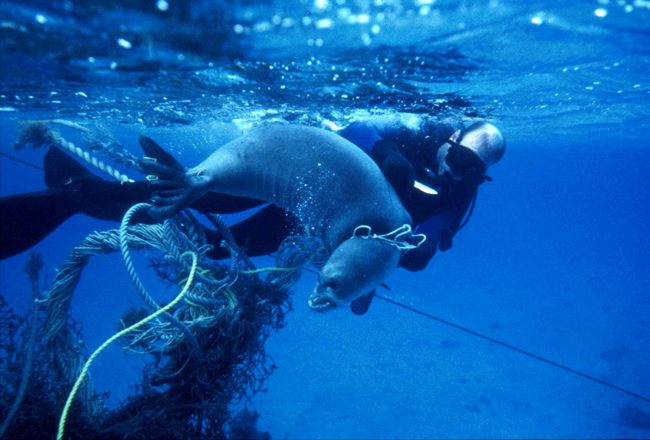

Entanglement is just one type of human interaction that harms marine animals. Other forms of human interaction may be fishing bycatch, seal bombs, or even just people shooting at the animals with a gun. Not as uncommon as you think. 

Also, seal bombs. I hadn’t heard about seal bombs until last night. People throw bombs at seals to scare them away. And also accidentally blow them up. The following quote is from the Friends of Animals website:
To catch fish, people have used explosive devices, hoping to deter marine mammals from interfering with their equipment or catch. Seal bombs still cripple those they are meant to deter… Seal bombs are small pieces of dynamite that can detonate under water. Often, a seal bomb is placed inside a fish and fed to a sea lion – even though deliberately using seal bombs to harm marine life is prohibited.

So please, if you would like to help out:
  • Cut up circular pieces of plastic and trash so that it cannot be caught around an animal’s neck.
  • Participate in beach cleanups to remove hazardous debris, or bring your own trash bag to fill up when you go to the beach.
  • Reduce your plastic use.
  • Be responsible for your fishing gear—don’t let it float away. Clean up all of your fishing lines and nets.
  • Don’t buy balloons.
  • Volunteer at a marine mammal center!
  • Spread the word.


06 April 2011

Plastic Debris Density Assessment Video!

So cool, I've made another video for STRP and another project called Sea Turtles Forever. Check it out!

18 March 2011

Plastic vs. Paper vs. Reusable cloth bags


I am getting absolutely SICK of these new articles that say plastic bags are more environmentally friendly than paper.

Can infants/toddlers and animals get caught in plastic and suffocate? Less likely.

Does plastic degrade in the environment? Not for hundreds if not thousands of years. (Nobody knows—they've only been around for half a century)

Not to mention, the only locations that recycle plastic bags are usually grocery stores. You know where you can recycle paper bags? Anywhere that takes paper.

This article and many others state that, "The findings of the report suggest that, in order to balance out the tiny impact of each lightweight plastic bag, consumers would have to use the same cotton bag every working day for a year, or use paper bags at least thrice rather than sticking them in the bin or recycling."


Oh thats funny, because I HAVE been using my reusable bags for over a year. I DO reuse paper bags until they rip or something and then I recycle them. People act like these actions are too inconvenient and stressful, when really, it's so simple I don't even think about it anymore.

03 March 2011

How I Reduced My Plastic Consumption Today!

This event came in perfect timing after my last post about the movie Bag It.

I managed to get some grocery shopping done today, and the first thing on my list was granola. I was at Whole Foods, my favorite place in the world, and walked down the cereal aisle grabbing a bag of Galaxy Granola—which is totally delicious by the way—realizing that it was in a plastic bag but not seeing anything that I could do about it. So I thought!
On the left is the bag of granola I ended up getting! Same brand as the one on the right but no plastic packaging!

The next aisle over they had rows and rows of chopped nuts, dried fruits, chocolate-covered goodies, grains, and GRANOLA in
self serve boxes, sold by the pound. I literally stood there for 15 minutes deciding whether I wanted to buy the granola in a plastic bag, or scoop out a pound of it myself and not have to waste plastic.


In the end I put the bag back and scooped out some unpackaged granola (SAME BRAND—
Galaxy Granola!!) into a paper bag I was reusing from a previous trip to Whole Foods. It
ended up weighing 1.15 lbs, which at $4.99/lb came out to be $5.73 or something like that. I can't remember what the pre-packaged Galaxy Granola cost (it was around $5). However, a single bag of Galaxy Granola only contains 0.75 lbs of granola (12 oz).

So in the end I definitely paid less for more, and didn't use plastic!

SCOOOORE!

02 March 2011

What I Learned From "Bag It"


Bag It is a documentary that follows the live of an average man as he discovers more and more about the world of plastic around us. I can honestly say that this movie changed my life for the better, I am so glad I decided to get off my butt and go see it! It is definitely a must see if you care about your health and the health of those around you!

Before I saw the movie Bag It, I had failed to notice that 99.9% of items sold at the market come packaged in plastic:
  • You weigh out your produce in plastic bags.
  • Berries come in plastic containers.
  • Jam, peanut butter, syrup, ketchup, mustard, and spices come in plastic containers (if not glass).
  • Even apples, oranges, and other foods with skins that act as “natural” packaging come wrapped in plastic.
  • Cereal comes in plastic.
  • Disposable plastic cups and utensils come in plastic bags.
  • Cookies and candy are sold in plastic packaging.
  • Bubble-wrap is plastic.
  • Soda, juices, and water come in plastic bottles.
  • DVDs and CDs are in plastic cartridges.
  • What’s your Xbox controller made of? Guitar Hero guitar?Plastic.
  • Soap, shampoo, and hair care products all come in plastic bottles.
I cut down that list to make this post shorter, but I hope you get the point. I never really thought of how much I consume, or cared to notice how much of what I bought ended up being thrown out. Having written multiple pieces about plastics for work and researched the Great Pacific Garbage Patch for school, I don’t know why I haven’t caught on earlier that plastic is everywhere, and it’s a problem. A simple enough problem, isn’t it? When we no longer want the plastic we just throw it away…
But where is “away?” “Away” means either in the recycling, or in the trash.

Just recieved an email with this photo from the Husky Energy Action Team (HEAT),
an environmental club at Northeastern University.

Most likely plastic goes in the trash. The movie is great in that it clearly shows how confusing recycling can be to people, and uncovers the reality that most plastics are not recycled anyway. When plastic bags are thrown away in trash they are easily blown away ending up caught in trees, storm drains, and creeks. They eventually make it into the ocean and kill close to 100,000 marine animals every year. THEY KILL SEA TURTLES :( So let’s stop using single use plastic bags, right? Reusable ones are more stylish anyway! And so are reusable water bottles! Have you realized that Evian is Naïve spelled backwards? Now you should feel like an idiot when you purchase a plastic water bottle. NEWS FLASH: Drinking from your tap is sexy and smart.
You may think that recycling is the best alternative, but that’s totally false (sorry to burst your bubble). Plastic bottles cannot be recycled into new bottles, the plastic is “downgraded” through the recycling process. So the best thing would be to just avoid them entirely. That's why "reduce" comes before "reuse" and "recycle." Something I didn't know until I watched Bag It.
In Bag It the narrator, an average dude, started off discovering problems with plastic bags. But the problems grew to problems with plastic bottles, which then led to problems with plastic food packaging. Problems with packaging led to chemicals in baby products and chemicals in products designed for everyday use. This ordinary guy just kept digging deeper and found not just plastic bags to be the problem, but the whole concept of “throw-away living” to be entirely destructive to the environment and the human body. It turned out that plastic bags were just the “tip of the iceberg.” There are so many other shocking issues brought up in this movie, I really hope you go see it for yourself.
Now that I've seen Bag It here are some things that I've been doing to minimize the plastic I consume.
  1. Absolutely NO plastic bottles of any kind. Bye-bye soda, it's been nice knowing you.
  2. Stop placing my produce in plastic bags at the grocery store. Whole Foods has paper bags now! And I plan on reusing them over and over again until they wear out. Eventually I'll either buy or make my own reusable mesh bags to take with me.
  3. Bring my reusable bags to the mall—not just the grocery store. On second thought, I am going to limit my trips to the mall, too.
  4. I have stopped microwaving food contained in plastic containers. After what I saw in the film, there is no way I can go back.
  5. Also at the grocery store, if there is a brand of peanut butter (or something else) in a plastic container and one in a glass container—I'll always go with the glass. The jars can be cleaned and reused around the house or they're easily recycled.
  6. Cut out canned food as much as possible. According to the movie aluminum cans are lined with a layer of plastic inside.
  7. My buddy and I get made fun of at school for picking plastic bottles out of the trash and throwing them into the recycling, but I'm going to keep doing it for the sake of generations to come. Plus that means more landfill space.
  8. Avoid products with tons of packaging, and avoid buying new products. Hello thrift stores! (There are three located conveniently near my house, so I can still get my shopping fix in. Also—you find great things you may not find anywhere else at thrift stores!)
Well these are just a few things I'm doing/planning on doing. There are probably others I'm overlooking! Make it a new part of your daily life to notice the overwhelming amount of plastic around you, and try to decrease your own impact!

Here's one issue that was addressed in the film, which I thought was very important for people to know:
Rubber duckies are made of plastic loaded with phthalates (chemicals that give the plastic its flexibility), which are highly toxic. Hooray for poisoning our children! Why are phthalates bad? Lower sperm counts, for one. Gender neutrality is occurring—boys are becoming more feminine and girls are becoming more masculine. And phthalates have been linked to ADHD symptoms. How do I avoid phthalates? Here's a link to one helpful website.
The serious health and environmental concerns resulting from our plastic manufacture and consumption are issues that need to be addressed by individuals like you and me. Unfortunately, our government is doing and will do absolutely nothing to protect its citizens from toxic chemicals that are found in plastic products. The only way we’re going to see change is if local communities and individuals like you and me make conscious decisions to refuse, reduce, reuse, and recycle (listed in order of importance!).
For more visit www.bagitmovie.com!

23 February 2011

Bag the Plastics & Save Turtles

Here's a little bit I wrote for the upcoming STRP newsletter:

Reduce Your Plastic Use to Save Sea Turtles
The growing amount of plastic waste in our oceans raises alarm for the safety and wellbeing of endangered sea turtles. Ingestion of plastic material or entanglement causes sea turtles to drown or die of starvation. By reducing the amount of plastic we release into our oceans we can drastically decrease the number of sea turtles that are dying due to plastics. 

Many cities have enacted bans on single use plastic bags distributed for convenience at grocery stores, which will reduce the amount of bags released into storm drains and creeks, and ultimately decrease the amount of plastic that reaches the sea. Bringing reusable bags to the grocery store, choosing paper instead of plastic bags at checkout, and carrying a reusable water bottle instead of buying plastic bottles are simple actions that could make a world of difference in the protection of marine life and sea turtles.

Here's a youtube vid I made last month for STRP's "Bag the Plastics" campaign:


31 January 2011

What YOU Can Do #1 - Convenience Will Kill You

You may think that making a difference takes a lot of effort and that you have to go wayyy out of your daily routine. The truth is, there are many little effortless things you can do that can make a difference. Hopefully I can convince you to take a step in the right direction...

One of the first and most important steps we can all take to a cleaner environment and healthy ecosystems is supporting city, county, state, even nation-wide Plastic Bag Bans. These convenient little floating globs made of polyethylene derived from gas and petroleum are literally choking the environment to death.


Literally.

BRING YOUR OWN REUSABLE BAGS WHEN YOU GO SHOPPING.
At the grocery store, at the mall, anywhere. Keep a stash of reusable bags in your car so you'll always have them when you do your shopping. This is perhaps one of the greatest steps we can take to reducing our waste output.

Why should we stop using single-use plastic bags?
  1. The Environmental Protection Agency has estimated that about 380 billion plastic bags are used in the U.S. annually.
  2. It was also estimated that only 5% of single-use plastic bags get recycled. Other sources say its closer to 1%. It's all bad
  3. Plastic bags account for more than 8% of marine litter.
  4. Plastic marine debris harms and kills 100,000 marine animals each year, over 200 species are affected.
  5. They've been banned already in more than 25% of the world. So you're way behind.
  6. You could choose to get stylish, cute reusable bags so you feel motivated to bring them everywhere! Make a fashion statement! Be unique! Look at this one!
  7. Out of sight, out of mind? Yeah, right. These suckers take up to 1000 years to degrade.

In California the cities of San Francisco, Fairfax, Oakland, San Jose, Malibu have bans on plastic bags, as well as Los Angeles County, and most recently Marin County--home of the Sea Turtle Restoration Project's headquarters.

Still not convinced? CHECK THIS VID OUT.


Sources:
http://www.nytimes.com/2007/04/01/weekinreview/01basics.html
http://environment.about.com/od/recycling/a/reusablebags.htm

and you should probably check this out too: http://lee.ifas.ufl.edu/fyn/fynpubs/thedangersofplasticbags.pdf